
For me, Christmas time is about sunshine, beaches, and braaing with my family and friends-the ultimate South African summertime celebration. It’s about coming together and having fun. To scare kids into behaving here, parents might joke that Father Christmas only gives coal to the truly naughty. But that’s about as scary as it gets!
Across Europe, however, the holiday season is steeped in truly chilling folklore. If you thought Krampus was the only scary Christmas figure, prepare to meet his terrifying friends.
1. Krampus (Austria/Bavaria, Central Europe)
The Krampus is the half-goat, half-demon antithesis to jolly St. Nicholas. Emerging from ancient pagan traditions, this terrifying figure is the ultimate enforcer whose sole purpose is not to reward, but to brutally punish naughty children often with birch rods. He looks truly demonic, sporting menacing horns, sharp fangs, and chains that rattle ominously as he hunts. His very name comes from the German word for “claw.” Traditionally, he carries a wooden tub or large basket on his back in which he scoops up and drags away bad children.
The height of his visibility is Krampusnacht on December 5th . This is when the famous Krampuslauf (Krampus Run) takes place, where drunk male adults dress in terrifying, elaborate costumes to chase and scare onlookers. Interestingly, while some German regions leave out cookies as an appeasement, in Austria, nothing is left out. The modern surge of interest has cemented him as an international holiday icon, complete with horror movies and warning-laden Krampus cards.


2 Grýla and the Yule Cat (Iceland)
In Iceland, children face not one, but three terrifying figures. Grýla, the monstrous ogress, lives in the mountains, and according to dark folklore, she boils and eats naughty children. Her appearance is consistently horrific, sometimes with giant goat horns, three heads, or unsettlingly large ears. She is the mother of the 13 mischievous Yule Lads.
Perhaps the most unique threat is The Yule Cat (Jólakötturinn), Grýla’s enormous feline pet. This giant beast eats anyone who doesn’t receive new clothes before Christmas Eve. This myth is thought to have a practical, underlying purpose: to encourage workers to finish their winter work, specifically wool spinning, to ensure every member of the household earns and receives a new piece of clothing for the harsh winter, or risk being devoured by the fearsome cat.
3. Mari Lwyd (Wales)
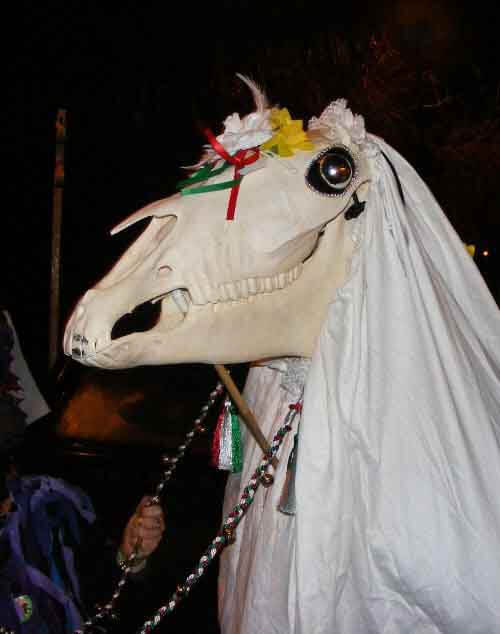
If you’re walking around Wales during the holidays, you might encounter a macabre, walking sight: the Mari Lwyd (Grey Mare), an eerie Christmas skeleton horse. This unique Welsh tradition involves a decorated horse skull mounted on a stick, carried by a person hidden beneath a sheet.
Groups of people carry the figure door-to-door, where they challenge the household to a pwnco—a hilarious, unique rhyming battle, or what some might call a Christmas rap battle. If the Mari Lwyd group wins the witty exchange, they are allowed to enter the house for traditional food and drink, merging the festive, the eerie, and the deeply traditional. No child eating with this myth at least.
4. Frau Perchta (Alpine Germany/Austria)
This fearsome Alpine figure is known chillingly as the “Belly Slitter,” a terrifying judge who visits homes during the Twelve Days of Christmas. Perchta’s purpose is to assess the productivity of the past year: rewarding the industrious and brutally punishing the lazy.
Her appearance is inconsistent but deeply mythological. She can appear as a glowing, beautiful woman, white as snow, or as a dark, haggard old crone with a wrinkled face, bright eyes, and a long, hooked nose. Her most unique feature, noted in many old descriptions, is her unusual foot—often a large “goose foot” or “swan foot.” This strange, splayed appendage hints at a mythological power and an ability to shapeshift. Her cruelest act? She tears open the stomach of the idle and fills it with stones or garbage.

5. Kallikantzaros (Greece & Southeastern Europe)
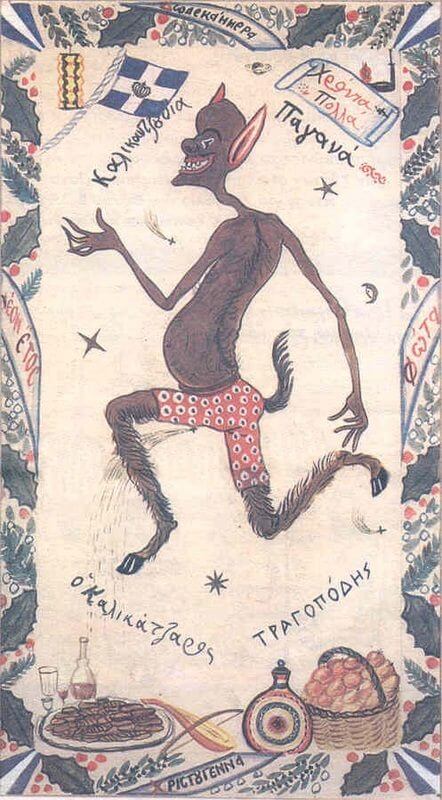
Adding a mischievous, demonic touch to the season are the Kallikantzaroi, a species of malevolent goblins. These ugly, troublesome sprites emerge from their subterranean home beneath the Earth’s core and wreak havoc in the human world from Christmas Day until the Epiphany (January 6th). During this period, they spoil food, cause confusion, and generally make life miserable.
To protect their homes, families keep their fireplaces burning continuously (as the Kallikantzaroi fear fire) and close doors and windows at night. In some regions, like the island of Cyprus, families will sprinkle sweet pancakes or pastries around the home to appease the goblins and encourage them to leave peacefully. A truly terrifying piece of folklore warns that if a child is born during the 12 days of Christmas, that child is at risk of turning into a Kallikantzaros themselves. They return underground on January 6th, when priests bless homes with holy water, restoring peace until next year.
6. Zwarte Piet / Black Pete (The Netherlands, Belguim)
This companion of Sinterklaas (the Dutch Santa Claus) is one of the most controversial figures in modern Christmas folklore. Setting aside the serious social debates, his traditional role was that of a creepy enforcer who kept track of the naughty children and was traditionally depicted as carrying the sack used to threaten and take children away to Spain
The reason for Spain is rooted in history: during periods of conflict between the Netherlands and Spain, Spain became the scary, distant, and unknown destination in the minds of Dutch children-the perfect, far-off land to threaten naughty kids with. The threat of being kidnapped and shipped away was often far scarier to Dutch children than the simple threat of a lump of coal.

7. The Hans Trapp (France and Germany)
Hans Trapp is the terrifying, rags-covered bogeyman of Alsatian Christmas tradition. As the fearsome companion to Saint Nicholas, he punishes naughty children while the Saint rewards the good. His chilling legend is rooted in the true history of Hans von Trotha, a notorious 15th-century knight who was excommunicated by the Pope after creating a disaster for the local abbey in Wissembourg. In the centuries following his death, the knight’s villainous reputation was immortalized by local custom, turning him into the frightening figure who now parades through the region, symbolizing the triumph of good over evil when he is finally driven back to his ancient lair at Berwartstein Castle.

8. Père Fouettard (France, Belgium, Switzerland)
The French equivalent of the Krampus is Père Fouettard, or “Father Whipper.” This chilling companion to Saint Nicholas performs a dual role on Saint Nicholas Day (December 6th): while Saint Nicholas dispenses gifts to the well-behaved children, Père Fouettard is there to dispense lumps of coal and, historically, beatings to the truly naughty. He is typically depicted as wearing dark, ragged clothing, with a wild beard, and always carrying a whip or a bundle of birch sticks.
What makes this character particularly dark is the grotesque legend surrounding his origin, which is said to be based on a real man. The myth states that Père Fouettard was originally a wicked butcher who, centuries ago, kidnapped and murdered three young boys who were traveling to a boarding school. He then cut up their bodies and hid them in a brine barrel. Saint Nicholas miraculously discovered the crime and resurrected the children. As punishment, the butcher was forced to repent and became the Saint’s eternal, dark servant, forever tasked with scaring children into behaving.

9. Knecht Ruprecht (Germany)
Knecht Ruprecht, translating to “Servant Rupert,” is one of the oldest and most popular companions of Saint Nicholas in German folklore. He acts as the terrifying counterbalance to the saint. On St. Nicholas Eve (December 5th), he appears to quiz children on their prayers and behavior. Well-behaved children receive treats, but naughty children are punished with switches (birch rods), which he carries in a sack, or they are presented with a lump of coal or stones. In the most frightening versions, he carries the bad children away in his sack.

10. Belsnickel (Germany, America and Brazil)
Forget the jolly man in the red suit for a moment and step into the older, rougher traditions of the season, where the German figure of Belsnickel holds court. He is from the Palatinate region of southwestern Germany along the Rhine (where i used to live),the Saarland, and the Odenwald area of Baden-Württemberg. The figure is also preserved in Pennsylvania Dutch communities and Brazilian-German communities.
Clad in ragged furs, often sporting a menacing mask or darkened face which is usually dirty, this “Nicholas in furs” arrives not with a silent sleigh, but with a dramatic entrance. He raps on the window or door. A character who embodies both the stern and generous sides of Christmas, Belsnickel is the ultimate holiday judge, visiting homes in the weeks before Christmas to personally vet children’s behaviour. Wielding a switch for the naughty and carrying a pocketful of cakes, candies, and nuts for the good, his visit is a moral test: children must account for their actions by reciting a Bible verse or poem. It’s a fascinating tradition that survived the journey from the Palatinate region of Germany to the Pennsylvania Dutch country, offering a vivid, complex, and slightly frightening contrast to the modern, purely benevolent Santa Claus.
Read more
https://africasacountry.com/2011/11/i-remember-black-pete
https://www.atlasobscura.com/articles/yule-cat-jolakotturinn-iceland
Smith, J. B. (2004). Perchta the Belly-Slitter and Her Kin: A View of Some Traditional Threatening Figures, Threats and Punishments. Folklore, 115(2), 167–186. http://www.jstor.org/stable/30035166
https://medium.com/@jahernandez_writes/the-tale-of-p%C3%A8re-fouettard-66260dc44890
https://frenchmoments.eu/hans-trapp/
We associate Christmas with joy and the spirit of giving, but many of these traditions have a darker side. In the Northern Hemisphere, where December can be cold, bleak, and lit only by candlelight in the past against snowy landscapes, it’s easy to see how chilling myths like Knecht Ruprecht or Krampus took hold. Rather than just festive cheer, these stories often serve as cautionary tales. They remind children (and adults) that misbehaviour comes with painful and sometimes deadly consequences.
Unlike my other posts the images here aren’t mine. They’re public domain and free to use. If you want to borrow any of these creepy visuals for your own post, please give credit to the original photographer. After all, you don’t want Krampus knocking on your door for not attributing!
Thanks so much for reading and please let me know if you knew any of this myths.


 Nikkidiscovers
Really interesting post. Mari Lwyd sounds excellent, it’s surprising that I’ve never heard about it before.
LikeLiked by 1 person
Thanks for the comment sometimes it feels like I’m sharing things everyone knows about. Hope you are enjoying the festive season
LikeLiked by 1 person